Peppermint Oil for Hair: Does It Actually Help with Hair Growth?
Peppermint oil is often touted as a natural hair loss remedy. Here's what the evidence actually supports, how to use it safely, and how it compares to proven treatments.
Written and medically reviewed by:

Key Takeaways
Peppermint oil has some plausible mechanisms for supporting scalp health, but the only study supporting its use for hair growth was conducted in mice. It is not licensed or recommended for hair loss in the UK. Diluted correctly, it is low-risk, but it is not a substitute for proven treatments.
Peppermint oil has some plausible biological reasons to influence hair growth, and one animal study produced genuinely interesting results. But there are no human clinical trials to back up the claims you'll find on most wellness websites, and it is not licensed or recommended by the MHRA, NICE, or the NHS for any hair loss condition. It may be a reasonable low-risk addition to a hair care routine, but it should not replace proven treatments if your hair loss is significant.
How the hair growth cycle fits in#
Your hair grows in cycles. The active growth phase is called anagen, and it can last two to seven years. This is followed by a brief transitional phase (catagen), and then a resting phase called telogen, when the hair sheds. On a healthy scalp, around 85-90% of follicles are in anagen at any given time.
Hair loss conditions like male pattern baldness (androgenetic alopecia) cause follicles to spend less time in anagen and progressively miniaturise. Any treatment that credibly prolongs anagen or increases the proportion of follicles in that phase could slow or reverse thinning. This is exactly where peppermint oil is theorised to act, though the evidence for that theory in humans is thin.
What the 2014 mouse study actually showed#
The most-cited piece of research compared four groups of mice: one treated with a 3% peppermint oil solution, one with 3% minoxidil, one with jojoba oil, and one with saline. After four weeks, the peppermint oil group showed increases in follicle number, follicle depth, and dermal thickness. On some measures it appeared to outperform minoxidil.
Those results are interesting, not conclusive. Mice are not people. Their hair follicle biology differs from ours, and a controlled animal model cannot account for the hormonal drivers of human androgenetic alopecia. The comparison with minoxidil in mice does not translate to equivalent efficacy in men. No human randomised controlled trial has been published since, which is a significant gap given the study was published over a decade ago.
Why peppermint oil might have an effect on the scalp#
There are a few plausible mechanisms, even if human evidence is lacking.
Increased blood flow. Peppermint's main active compound, menthol, is a vasodilator. A 2016 study in Microvascular Research found that a 4% menthol solution increased blood flow to surface tissues — though that study did not involve scalp tissue or hair follicles, so the relevance to follicle nutrient delivery is speculative and not established.
Anagen activation. The 2014 mouse study found upregulation of growth factors associated with the anagen phase. The precise mechanism behind this finding is not fully understood.
Scalp environment. Peppermint has mild antimicrobial and anti-inflammatory properties. A healthier scalp environment could support follicle function, particularly if conditions like seborrhoeic dermatitis are contributing to shedding. This is a more plausible role for peppermint oil than direct follicle stimulation in androgenetic alopecia.
DHT and male pattern baldness. Some sources claim peppermint oil blocks DHT, the hormone that drives follicle miniaturisation in male pattern baldness. There is no meaningful human evidence to support this. Finasteride works by inhibiting the enzyme that converts testosterone to DHT, and its efficacy is well documented. The idea that topical peppermint oil exerts a comparable hormonal effect at the doses used in scalp treatments is not supported by published data. If DHT is the issue, it needs a proven intervention.
How to apply it safely#
Pure peppermint essential oil must be diluted before applying it to your scalp. Undiluted essential oils can cause contact dermatitis, chemical burns, and in some cases trigger telogen effluvium, which is the very type of hair shedding you are trying to avoid.
A safe starting concentration is around 2-3% in a carrier oil. That means roughly 3-4 drops of peppermint essential oil in a teaspoon (5ml) of carrier oil. Suitable carrier oils for scalp use include jojoba (closely mimics sebum and absorbs well), grapeseed (light, non-greasy), or fractionated coconut oil. Thick coconut oil can be harder to wash out and may feel heavy on the scalp.
Patch test protocol: Apply a small amount of your diluted mixture to the inside of your forearm. Wait 24 hours. If you see redness, itching, or swelling, do not apply it to your scalp. Peppermint oil is a known allergen for some people, and the scalp is more sensitised than the forearm, so a reaction there will be worse.
If the patch test is clear, massage a small amount into the scalp (not the hair lengths) two to three times per week. Leave it on for at least 30 minutes before washing out, or overnight if your scalp tolerates it.
On UK product labels, look for the INCI name Mentha Piperita (Peppermint) Oil. Avoid products that list "peppermint fragrance" or "menthol fragrance" as the active ingredient, as these are synthetic substitutes and will not behave the same way. Reputable UK suppliers of essential oils include those certified by the Aromatherapy Trade Council, which sets quality standards for purity.
If you experience scalp irritation, redness, or increased shedding after starting use, stop immediately and allow a few weeks to pass before reassessing.
How it compares to licensed treatments#
To put peppermint oil in context, here is a straightforward comparison:
| Treatment | Evidence level | MHRA licensed | Approx. monthly cost (UK) |
|---|---|---|---|
| Peppermint oil (DIY) | Animal study only | No | £3-6 |
| Minoxidil (topical) | Multiple human RCTs | Yes | From £33.60 (60ml) |
| Finasteride 1mg | Multiple human RCTs | Yes (men only) | £14.99 for 28 tablets |
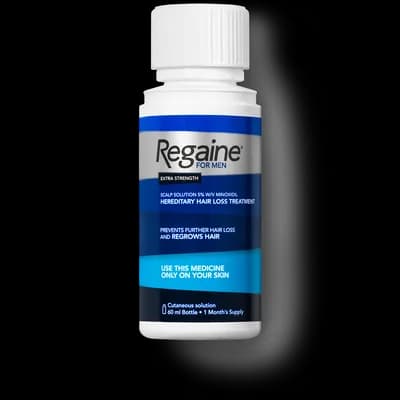
Peppermint oil is cheap and low-risk when used correctly. Licensed treatments for male pattern baldness, available through services like Totiva's hair loss clinic, have a substantially stronger evidence base. Finasteride 1mg tablets start from £14.99 for 28 tablets at Totiva, and Regaine (minoxidil) solution from £33.60 for 60ml.
Got questions? Speak to a pharmacist on WhatsApp now
Prefer to browse first? View treatments
Using peppermint oil alongside licensed treatments#
There is no known pharmacological interaction between topical peppermint oil and either minoxidil or finasteride. If you are already using one of these treatments and want to add peppermint oil to your routine, the practical concern is more about scalp tolerance than drug interactions. Apply minoxidil first and let it dry fully before applying peppermint oil. Avoid mixing them in the same application, as this can affect minoxidil absorption.
If you are on finasteride, peppermint oil applied to the scalp is unlikely to interfere with the drug's systemic DHT-lowering effect.
Who is least likely to benefit#
If your hair loss is driven by androgenetic alopecia, peppermint oil is unlikely to address the root cause. The hormonal miniaturisation process needs a hormonal or pharmacological response. Peppermint oil may offer more value in hair loss linked to scalp inflammation, poor scalp hygiene, or mild telogen effluvium (stress or illness-related shedding), where improving the scalp environment is part of recovery.
Women experiencing significant hair loss — whether from female pattern hair loss, postpartum shedding, or other causes — should speak to their GP. There are no human studies of peppermint oil in these populations, and underlying causes including thyroid dysfunction, iron deficiency, or hormonal changes are common and treatable. Totiva currently treats men only.
For a broader look at how hair follicles respond to different treatments, the hair growth cycle guide covers the anagen, catagen, and telogen phases in more detail. If you are considering whether minoxidil might be the right step, the finasteride vs minoxidil comparison is worth reading before you start.
Medical Information: This article is for informational purposes only and does not constitute medical advice. Always consult a qualified healthcare professional before starting, stopping, or changing any treatment.