Fat vs Muscle: Body Composition Explained
The scales can lie. Here's what fat and muscle actually do in your body, how to tell which you're gaining or losing, and what healthy looks like for your age.
Written and medically reviewed by:

Key Takeaways
Fat and muscle weigh the same per unit but muscle is denser and burns more calories at rest. The scales alone cannot tell you which you are gaining or losing. Protein, resistance training, and sleep determine the ratio.
Fat and muscle are both essential tissues, but they behave very differently in your body. A kilogram of fat and a kilogram of muscle weigh exactly the same, but muscle is roughly 18% denser (an approximate figure based on published tissue density values), so it takes up less space. That's why two people with identical weights can look and feel completely different, and why the scales are an unreliable guide to whether your health is improving.
How fat and muscle actually differ#
Fat tissue (adipose tissue) is your body's long-term energy store. It also cushions organs, insulates against cold, and helps regulate hormones including oestrogen and cortisol. Not all fat is equal, though. Subcutaneous fat sits just under the skin and is relatively harmless in moderate amounts. Visceral fat wraps around the abdominal organs and is the type most strongly linked to type 2 diabetes, cardiovascular disease, and inflammation. You cannot feel visceral fat by pinching your skin, which is one reason waist circumference is often a better health indicator than total weight.
Muscle tissue is metabolically active. It burns calories at rest, supports every movement you make, stabilises your joints, and plays a direct role in how your body handles glucose. Higher muscle mass is associated with better insulin sensitivity, lower cardiovascular risk, and improved long-term survival. When researchers talk about "body composition", this is the ratio they care about: how much of your weight is lean tissue versus fat.
| Body fat | Skeletal muscle | |
|---|---|---|
| Density | Lower (floats on water) | Higher (sinks) |
| Calorie burn at rest | Minimal | Burns approximately 13 kcal per kg per day |
| Role in hormones | Produces oestrogen, leptin, adipokines | Releases myokines; improves insulin sensitivity |
| Health risk (excess) | Cardiovascular disease, type 2 diabetes, certain cancers | Excess is rarely harmful |
| Changes with age | Tends to increase, especially visceral | Declines from around age 30 (sarcopenia) |
What counts as a healthy body fat percentage#
BMI is the tool UK GPs use for screening, but it has a well-known blind spot: it cannot distinguish fat from muscle. A person with high muscle mass may be classified as "overweight" despite having low body fat. Conversely, someone with a normal BMI can carry dangerous levels of visceral fat. This is particularly relevant for people of South Asian heritage, where cardiometabolic risk appears at lower BMI thresholds.
Body fat percentage gives a clearer picture. Broadly accepted healthy ranges in adults are:
| Age group | Women (healthy range) | Men (healthy range) |
|---|---|---|
| 20-39 | 21-32% | 8-19% |
| 40-59 | 23-33% | 11-21% |
| 60+ | 24-35% | 13-24% |
Women naturally carry more fat than men, partly because of reproductive hormones and partly because of structural differences in fat distribution. During perimenopause and menopause, oestrogen decline causes fat to shift from the hips and thighs towards the abdomen, increasing visceral fat even when total weight barely changes. This is one reason women in their 40s and 50s often report that their clothes fit differently despite not gaining weight on the scales.
How to actually measure your body composition in the UK#
There is no single perfect method, and accuracy varies considerably:
DEXA scan is the clinical gold standard. It uses low-dose X-ray to measure fat mass, lean mass, and bone density separately. Not available routinely on the NHS for body composition (it is used for bone density assessment in osteoporosis). Private DEXA scans at clinics and gyms typically cost £100-200. Some PureGym and independent fitness studios offer InBody scans (bioelectrical impedance analysis) for £20-50, which are less precise but give a reasonable estimate of fat versus muscle when done consistently.
Smart scales at home use bioelectrical impedance too. Results are affected by hydration, time of day, and recent exercise, so use them at the same time each morning for trend data rather than treating a single reading as fact.
Waist circumference is free and clinically useful. The NHS recommends keeping waist circumference below 80cm for women and 94cm for men. Above 88cm (women) or 102cm (men) is associated with significantly higher risk of metabolic disease.
Skinfold calipers can be accurate when used by a trained practitioner, but results depend heavily on technique.
Can fat turn into muscle?#
No. Fat and muscle are completely different tissue types. Fat cannot convert into muscle, and muscle cannot turn into fat if you stop training. What actually happens when you start resistance training in a calorie deficit is body recomposition: you lose fat stores while simultaneously building new muscle protein. The two processes happen in parallel, not by one transforming into the other.
Body recomposition is slower than either pure fat loss or pure muscle gain. Research suggests beginners and people returning after a break see the clearest recomposition results, typically 0.5-1kg of fat lost and 0.25-0.5kg of muscle gained per month under good conditions. That sounds modest, but after three to six months the visual change is usually noticeable even when the scales barely move. This is exactly the situation where trusting the mirror and your measurements matters more than trusting your weight.
Gaining muscle or losing fat: how to tell the difference#
Without body composition testing, these are the most reliable signals:
- Clothes fit looser in the waist but tighter across the shoulders or thighs: probably gaining muscle and losing fat
- Weight is increasing and clothes feel tighter everywhere: probably gaining fat
- Weight is dropping but you feel weaker and more fatigued: possibly losing muscle alongside fat
- Weight is stable but you look leaner: body recomposition is happening
Strength in the gym is a useful proxy. If your lifts are going up over weeks, your muscles are growing.
Got questions? Speak to a pharmacist on WhatsApp now
Prefer to browse first? View treatments
Protein, training, and what actually preserves muscle#
The biggest mistake people make during calorie restriction is not eating enough protein. When you cut calories sharply, your body will break down muscle for energy if protein intake is too low. The American College of Sports Medicine recommends 1.2-2.0g of protein per kilogram of body weight per day for active adults trying to preserve muscle — this is higher than the UK NHS/SACN reference nutrient intake and is intended for those engaged in regular physical activity. For a 70kg woman, that is 84-140g daily. Spreading protein across three to four meals works better than loading it all at dinner.
Resistance training is equally important. The NHS recommends at least two sessions of muscle-strengthening activity per week alongside 150 minutes of moderate cardio. That combination, rather than cardio alone, produces better body composition outcomes over time. Cardio burns calories during exercise; resistance training raises your resting metabolic rate by adding metabolically active muscle tissue.
Sleep and stress matter too, though they rarely get mentioned alongside diet and exercise. Poor sleep raises cortisol, which promotes visceral fat storage and accelerates muscle breakdown. Adults consistently sleeping under six hours show higher rates of fat gain even in controlled calorie studies.
How GLP-1 medications affect fat and muscle#
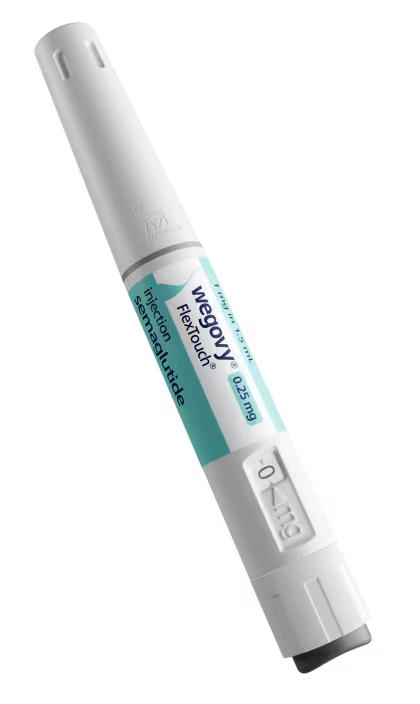
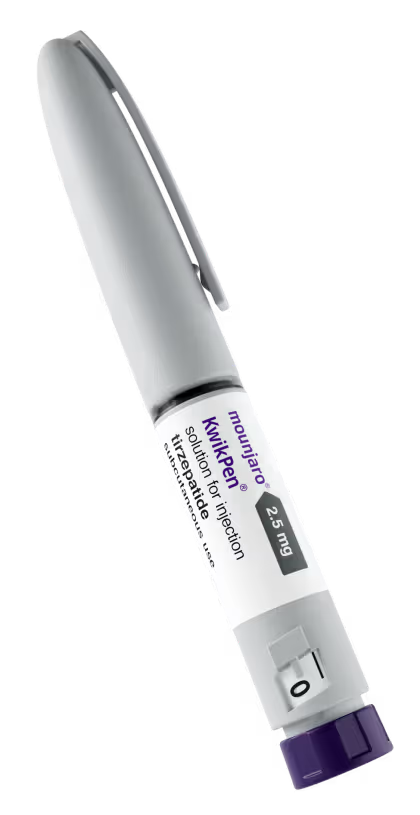
Semaglutide is available as Wegovy, which comes in both an oral tablet (taken once daily) and as an injectable pen, including the Wegovy 7.2mg multi-dose pen. Mounjaro (tirzepatide) is a weekly injectable that works as a dual GIP/GLP-1 receptor agonist — a distinct mechanism from semaglutide, which acts on GLP-1 receptors alone. Clinical trials have reported average weight losses of 15-22% of body weight with these treatments. However, rapid weight loss from any cause, including these medications, carries a risk of losing muscle alongside fat. Evidence on the precise proportion of weight loss attributable to lean tissue varies across studies, which makes adequate protein intake and resistance training especially important for people on these treatments.
If you are currently using or considering Wegovy or Mounjaro, the related guide on building muscle on Mounjaro covers the evidence in more detail.
If you are interested in whether one of these treatments might be appropriate for you, Totiva offers a free online consultation — please note that treatment suitability is determined by a clinician and results vary between individuals: start a weight loss consultation here.†
How long does meaningful change take?#
Set realistic expectations or the first plateau will feel like failure:
- Fat loss: A safe, sustainable rate is 0.5-1kg per week in a moderate calorie deficit (around 500 kcal below maintenance). Faster loss increases the risk of muscle loss.
- Muscle gain: Beginners can gain 1-2kg of muscle per month in the first few months. After the first year, 0.5-1kg per month is realistic. Women typically gain muscle at roughly half the rate of men due to lower testosterone.
- Body recomposition (both simultaneously): Slower than either alone. Expect three to six months before the visual change is clearly measurable.
Age-related muscle loss (sarcopenia) starts gradually from around 30 and accelerates after 60, with losses of 0.5-1% of muscle mass per year if untreated. This makes consistent resistance training increasingly important with age, not less.
Ready to see if treatment could work for you?
Who should prioritise fat loss, and who should prioritise muscle gain?#
Prioritise fat loss if: your waist circumference is above the NHS thresholds, your GP has flagged metabolic risk factors, or your body fat percentage is well above the healthy range for your age and sex.
Prioritise muscle building if: you are in a healthy fat range but feel weak or get injured easily, you are over 50 and want to protect your long-term mobility, or you are losing weight rapidly (through diet or medication) and want to protect lean tissue.
Work on both simultaneously if: you are new to structured exercise, you are returning after a long break, or you are in the early stages of a weight-loss programme and eating enough protein to support it.
The scales tell you one number. Body composition testing, waist measurement, and how you actually feel and move tell you far more.
† Treatment suitability requires clinician assessment. Individual results vary.
Medical Information: This article is for informational purposes only and does not constitute medical advice. Always consult a qualified healthcare professional before starting, stopping, or changing any treatment.