Topical Finasteride Side Effects: Milder on Paper, Less Well Tested
Topical finasteride mainly risks scalp irritation. Body-wide side effects look less likely than with tablets, but the evidence is thin. Here is what we know.


Key Takeaways
Topical finasteride mostly risks scalp irritation. Body-wide side effects look less likely than with tablets, but the trials are short, and it is not licensed in the UK. Report any mood or sexual changes promptly.
Topical finasteride can irritate the scalp, causing itching, redness and dryness. Body-wide side effects, such as low sex drive, erection problems and low mood, look less likely than with tablets because less of the drug reaches your blood. But "less likely" is not "proven safe". The trials are short and small, and the product is not licensed in the UK.
Where topical finasteride stands in the UK#
Oral finasteride 1mg is the licensed finasteride treatment for male pattern hair loss in the UK. Topical finasteride (a spray or solution) is not licensed for this. When it is supplied, it is usually an unlicensed "special", made for a named patient under the prescriber's responsibility.
That does not make it illegal or unsafe. It does mean the product has not been through the full MHRA licensing process. Strength, ingredients and quality can vary between suppliers.
The NHS does not usually prescribe finasteride for male pattern hair loss, as it is seen as cosmetic. Most men pay for a private prescription.
How common are the side effects?#
For tablets, we have good numbers. In the first year of the licensed 1mg trials, about 1 to 2 in 100 men reported each of these: lower sex drive, erection problems or an ejaculation problem. That was slightly more than with placebo.
For topical finasteride, the data is much thinner. The main trial is a phase 3 study of a 0.25% spray (Piraccini and colleagues, 2022). Around 450 men used the spray or a placebo for 24 weeks. Men on the spray did not report clearly more side effects than those on placebo, including sexual ones.
That is reassuring, but it has limits. If an effect affects 1 or 2 in 100 men, a 24-week trial of this size cannot tell "rare" from "none". A systematic review of topical finasteride (Lee and colleagues, 2018) reached a similar conclusion: the studies are small and short.
| Side effect | Tablets (1mg) | Topical finasteride |
|---|---|---|
| Itching, redness, dryness, stinging | Not expected | The most likely effect, mostly mild in trials |
| Lower libido, erection or ejaculation problems | About 1 to 2 in 100 in year one | Not clearly higher than placebo, but trials are short |
| Low mood, anxiety | Reported, with an MHRA warning | No good data, so treat the warning as relevant |
| Breast tenderness or swelling, testicular pain | Reported | Too little data to say |
Free 2-minute hair loss assessment
Tell us about your hair loss and a pharmacist will recommend the treatment most likely to work for you.
Why a scalp treatment may carry less risk#
Finasteride blocks an enzyme (5-alpha reductase) that turns testosterone into DHT. DHT shrinks hair follicles in male pattern hair loss.
A tablet is absorbed into your whole body. Applied to the scalp, the drug mainly acts where you put it. Studies show topical use lowers scalp DHT, while blood DHT falls by less than it does with tablets.
But some finasteride still gets through your skin into your blood. That is why the possibility of body-wide effects cannot be ruled out.
Oral and topical finasteride: other differences#
The side effects and licensing differences are covered above. These are the remaining points of comparison.
| Oral 1mg tablet | Topical spray or solution | |
|---|---|---|
| Evidence base | Large, long-term trials | A few small, short trials |
| Absorption into the blood | Full | Lower, but not zero |
| Cost | Low cost, widely available | Varies by supplier |
Our guide to topical finasteride results covers how well it grows hair.
Keeping irritation down#
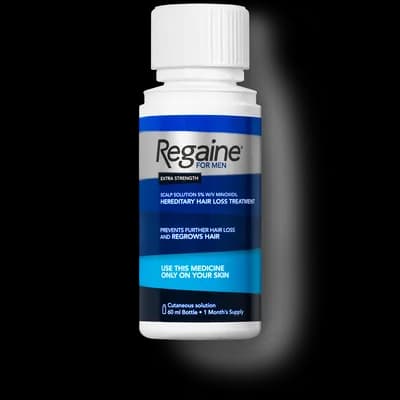
Spray and solution products are usually alcohol-based, and alcohol can dry and sting the scalp. Minoxidil solutions also contain propylene glycol, which is a known cause of scalp irritation and contact allergy.
A few sensible habits help:
- Follow your prescriber's dose and frequency. More does not work better.
- Apply to a dry scalp, and wash your hands afterwards.
- Try a small area first and watch it for a day or two. There is no formal UK protocol for this, but it is a common-sense precaution.
- Let it dry before touching your hair, lying on a pillow or letting anyone touch your scalp.
- If your scalp becomes sore or blistered, stop and ask your prescriber about a different form.
Hair loss treatments we prescribe
The gold-standard hair loss combo
Who should avoid it#
Finasteride can harm a male baby's development. Women who are pregnant or could become pregnant should not handle crushed tablets. That advice is written for tablets. We do not know how much finasteride, if any, could pass from treated skin to another person, because this risk has not been measured. As a cautious step, let the product dry fully and ask your prescriber for advice if you live with someone who is pregnant or could become pregnant.
Finasteride is also not for children. Tell your prescriber if you have liver disease. Reports of lower sperm quality and male infertility exist with finasteride, and these sometimes improved after stopping. Mention this if you are trying for a baby.
Finasteride can lower PSA, a blood marker used to check for prostate problems. Tell any GP or nurse doing a PSA test that you use it, so they read the result correctly.
When to stop and get help#
The MHRA warnings about finasteride were issued for 1mg tablets. The same active ingredient is in topical products, and some reaches the blood. Treat these warnings as relevant to you.
Stop using it and speak to your prescriber, pharmacist or GP promptly if you notice:
- Low mood, anxiety or thoughts of harming yourself.
- A drop in sex drive, erection problems or ejaculation changes that do not settle.
- Breast tenderness, swelling, lumps or nipple discharge.
- Testicular pain.
- A spreading, blistering or very sore rash on your scalp.
For thoughts of harming yourself, get help the same day. Contact your GP or NHS 111, or call Samaritans free on 116 123. Call 999 if you are in immediate danger. Call 999 too if your lips or face swell or you struggle to breathe.
With tablets, the MHRA says sexual problems can continue after stopping, and some men report this. We do not know if topical use can do the same, because the studies are too short. Our guide to post-finasteride syndrome explains what is known, without alarm.
You can also report a suspected side effect yourself through the MHRA Yellow Card scheme. Reports from patients help the MHRA spot patterns.
Buying it safely#
For a prescription product, check three things. The pharmacy should be on the GPhC register, and an appropriately registered UK prescriber should assess you. Unlicensed specials should come from a supplier with a legal manufacturing licence.
Avoid sellers who skip a consultation or will not say where the product is made. Unregulated products may not contain the stated strength.
Totiva does not supply topical finasteride. If the safety questions put you off it, you have other options. You can discuss licensed tablets, or minoxidil, which is used on the scalp and has a long track record. Licensed finasteride 1mg tablets at Totiva cost £9.49 for 28. You can see the options on our hair loss treatment page, and our clinicians can talk you through the choices.
Is Finasteride right for you?
From£9.49
A short online consultation is all it takes. A pharmacist reviews your answers, and you only pay if you're approved.
- GPhC-registered pharmacists
- Free online consultation
- Discreet, tracked delivery
Frequently asked questions
- 1
Piraccini BM et al. (2022). Efficacy and safety of topical finasteride spray solution for male androgenetic alopecia: a phase III, randomized, controlled clinical trial. Journal of the European Academy of Dermatology and Venereology
- 2
Lee SW et al. (2018). A systematic review of topical finasteride in the treatment of androgenetic alopecia in men and women. Journal of Drugs in Dermatology
- 3
BNF (2025). Finasteride | Drugs | BNF. British National Formulary, NICE
View source - 4
MHRA (2014). Supply unlicensed medicinal products (specials). MHRA Guidance Note 14, GOV.UK
View source
Medical Information: This article is for informational purposes only and does not constitute medical advice. Always consult a qualified healthcare professional before starting, stopping, or changing any treatment.