
Topical Finasteride vs Oral Finasteride: Tablets Have the Better Evidence
Finasteride tablets are the licensed, best-tested option. Topical finasteride is off-label with smaller, shorter trials. Here is how to choose between them.


Key Takeaways
Finasteride 1mg tablets are the licensed, best-proven option. Topical finasteride is off-label, with smaller and shorter trials, and lower but not zero absorption. Neither removes side effect risk, so talk to a prescriber.
For most men, the 1mg tablet is the better choice. It is the only form licensed in the UK for male pattern hair loss, and it has years of trial data behind it. Topical finasteride is an off-label alternative. The early results look promising, but the studies are smaller and shorter. It also does not remove the risk of side effects.
The usual reason to look at topical is worry about sexual or mood side effects. That is a fair concern. Here is how the two compare, and who each one suits.
Tablet and topical side by side#
| Finasteride 1mg tablet | Topical finasteride | |
|---|---|---|
| UK licence | Yes, for male pattern hair loss in men aged 18 to 41 | No licensed product, used off-label |
| How you take it | 1 tablet once a day | Solution or spray on the scalp, usually once a day, as your prescriber directs |
| Typical strength | 1mg | Often 0.25%, sometimes mixed with minoxidil |
| Evidence | Large trials, up to 5 years and longer | A few small or short trials, mostly 16 to 24 weeks |
| Effect on blood DHT | Falls by about 70% | Falls by less, but not zero |
| Side effects | Sexual and mood effects are recognised. Reduced sex drive is listed as common (between 1 in 100 and 1 in 10 men) | Scalp irritation, plus a smaller systemic risk that is not well measured |
| Speed | Slowed shedding in 3 to 6 months | Broadly the same timeline |
| Where to get it | Pharmacies and online prescribers | Specialist prescribers using made-to-order "specials" |
| Cost | Low (generic) | Usually higher |
How strong is the evidence for each?#
The tablet has the stronger evidence. In the landmark US trials, about 83% of men on 1mg had no further visible hair loss after 2 years, compared with 28% on placebo. A 5-year follow-up showed the benefit held up for most men who kept taking it.
The topical evidence is thinner. The best trial so far was a phase III study of a 0.25% finasteride spray in around 450 men. It ran for 24 weeks and beat placebo for hair counts. It compared the spray with placebo, not with the tablet, so it cannot tell us how the two measure up. A small trial of 40 men found a 1% gel and the tablet gave similar results over 6 months. A 2023 pilot study (Bharadwaj et al., published in the International Journal of Trichology) compared 0.25% finasteride combined with 5% minoxidil against each treatment on its own. It was small and open-label, so patients and doctors knew who was getting what. That makes it an early signal rather than firm proof.
So "promising" is a fair description of what we know so far. The words "proven" and "equivalent" are not. Nobody has run a long, large trial of topical against the 1mg tablet. If you have advanced thinning, that gap matters. You can read more about what regrowth to expect from topical finasteride.
Free 2-minute hair loss assessment
Tell us about your hair loss and a pharmacist will recommend the treatment most likely to work for you.
What "lower exposure" really means#
Finasteride works by blocking the enzyme that turns testosterone into DHT. DHT is the hormone that shrinks hair follicles in male pattern baldness. The tablet lowers DHT throughout the body by about 70%.
Applied to the scalp, finasteride still reaches the bloodstream. Studies of topical products show a smaller fall in blood DHT, but the size of the fall varies with the strength, the amount used and the area covered. Lower exposure is a sensible theory for fewer side effects. It is not a guarantee.
The topical trials were too small and too short to say how often rare problems happen. A 2025 systematic review and meta-analysis of randomised trials (Bai et al., in JAAD Reviews) looked at adverse events with topical finasteride. Pooling trials does not fix this gap, because a review can only be as reliable as the trials it combines. A short trial can show that a problem is not common. It cannot show that a problem is rare.
Side effects of each#
The UK product information for the 1mg tablet lists decreased sex drive as a common side effect, affecting between 1 in 100 and 1 in 10 men. Other sexual effects, such as erection problems and ejaculation changes, are reported less often. In the tablet trials, sexual side effects were reported by roughly 1 to 2 in 100 men, with slightly fewer men on placebo reporting them. For most men these settle, but some report them continuing after stopping.
The MHRA has issued repeated safety updates on finasteride. They cover depression, anxiety, suicidal thoughts and sexual problems that may continue after you stop. Tablets now come with a patient alert card. If you feel low or have thoughts of harming yourself, stop and get medical advice straight away. There is more on this in our guide to post-finasteride syndrome.
These warnings are written for finasteride as a medicine. A topical product is the same medicine, so it is sensible to take the warning seriously there too, even though the risk may be lower.
Topical use adds its own problems. These include a dry, itchy or red scalp and contact dermatitis. The solution often contains propylene glycol or alcohol, which some people react to. Minoxidil mixtures can make this more likely.
If you get a side effect from any form, you can report it through the Yellow Card Scheme. This applies to unlicensed products too.
Getting each one in the UK#
The NHS does not normally prescribe finasteride for hair loss, so treatment is private. Your GP can still help if you have mood or sexual side effects.
Generic 1mg tablets are cheap. At Totiva, the price is £9.49 for 28 tablets, £26.99 for 84 and £48.99 for 168. There is no subscription, and you pay only after the clinician approves treatment.
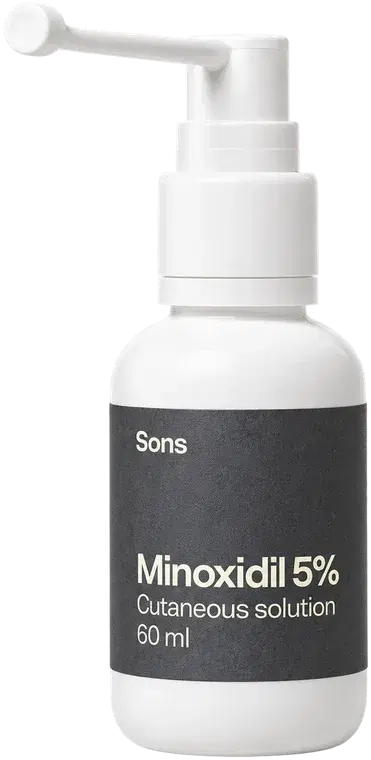
Topical finasteride is harder to find. It is made as a "special", which is an unlicensed medicine produced to order by an MHRA-licensed manufacturer. The prescriber takes responsibility for choosing it, because it has no marketing authorisation. High street pharmacies rarely stock it. Expect to pay more than for generic tablets, and check the price before you commit.
Whichever you choose, use a pharmacy or prescriber that is on the GPhC register. A genuine online service will ask about your medical history and will not hand over prescription medicines without a consultation. Totiva supplies finasteride tablets and minoxidil, but not topical finasteride.
Hair loss treatments we prescribe
The gold-standard hair loss combo
Which one suits you?#
- You want the best-proven, licensed treatment: choose the tablet.
- You are worried about sexual or mood side effects: topical is a reasonable thing to discuss, as long as you accept the weaker evidence. It is not risk-free. A prescriber should check your history first.
- You already have a history of depression or sexual problems: neither option is automatically safe. Talk it through with a clinician before starting either.
- You have advanced hair loss or a bald crown: the tablet has far more data behind it.
- You want to avoid hormone effects altogether: minoxidil does not affect DHT. See our comparison of finasteride and minoxidil.
- You are over 41: the licence stops at 41. Using the tablet beyond that is a prescriber's decision.
- You want to keep things simple: one cheap tablet a day is easier than a daily scalp routine.
Dutasteride is a stronger DHT blocker, but it is not licensed for hair loss in the UK. We cover it in dutasteride vs finasteride.
What to expect, and what happens if you stop#
The timeline is the same for both. Shedding often slows after 3 to 6 months. Judge the result at 12 months, not sooner. If there is no change by then, ask your prescriber to review it. Switching form is something they decide with you.
Both only work while you use them. If you stop, hair loss usually returns within about 12 months, and the hair you gained is lost.
Safety points that apply to both#
- Pregnancy: women who are or may be pregnant should not handle crushed or broken tablets. They should also avoid touching the topical solution or skin where it has just been applied. Finasteride can harm a male baby's development. Wash your hands after applying it.
- Blood donation: the UK blood services ask you to wait 1 month after your last dose. Check current rules before you donate.
- PSA tests: finasteride lowers PSA, the prostate blood test marker, by about half. Tell your GP you take it so a result is not misread.
- Fertility: finasteride can reduce semen volume, and there are rare reports of lower sperm counts that improved after stopping. If you are trying for a baby, raise it with your prescriber.
A tablet-and-topical combination is not a standard approach, and we cover it in the FAQs. A single solution mixing finasteride with minoxidil is more common. Our guide on finasteride and minoxidil together covers how that works.
If you want to start with the licensed tablet, you can begin a free hair loss consultation with Totiva and a UK clinician will check whether it suits you.
Is Finasteride right for you?
From£9.49
A short online consultation is all it takes. A pharmacist reviews your answers, and you only pay if you're approved.
- GPhC-registered pharmacists
- Free online consultation
- Discreet, tracked delivery
Frequently asked questions
- 1
Piraccini BM et al. (2021). Efficacy and safety of topical finasteride spray solution for male androgenetic alopecia: a phase III, randomized, controlled clinical trial. Journal of the European Academy of Dermatology and Venereology
- 2
Bharadwaj A et al. (2023). Comparative efficacy of topical finasteride (0.25%) in combination with minoxidil (5%) against 5% minoxidil or 0.25% finasteride alone in male androgenetic alopecia: a pilot, randomized open-label study. International Journal of Trichology
- 3
Bai JQA et al. (2025). Adverse events of topical finasteride for male androgenetic alopecia: a systematic review and meta-analysis of randomized controlled trials. JAAD Reviews
- 4
Kaufman KD et al. (1998). Finasteride in the treatment of men with androgenetic alopecia. Journal of the American Academy of Dermatology
- 5
Finasteride Male Pattern Hair Loss Study Group (2002). Long-term (5-year) multinational experience with finasteride 1 mg in the treatment of men with androgenetic alopecia. European Journal of Dermatology
View source - 6
MHRA (2026). Finasteride and Dutasteride – updated safety warnings for psychiatric side effects and sexual dysfunction. Drug Safety Update, GOV.UK
View source - 7
NHS (2024). Finasteride: a medicine for enlarged prostate or hair loss in men. NHS Website
View source - 8
Electronic Medicines Compendium (2023). Package leaflet: Information for the user, Finasteride 1 mg film-coated tablets. medicines.org.uk
View source
Medical Information: This article is for informational purposes only and does not constitute medical advice. Always consult a qualified healthcare professional before starting, stopping, or changing any treatment.


