Where to Inject Semaglutide and Mounjaro: A Practical Guide
Not sure where to inject your medication? This guide covers injection sites, technique and rotation for semaglutide and Mounjaro.


Key Takeaways
Semaglutide and Mounjaro both go subcutaneously into the abdomen, thigh or upper arm. Rotate sites every time to prevent tissue hardening.
Self-injecting medication for the first time can feel daunting. Most people feel a bit anxious about it, and that's completely normal. The good news is that once you've done it a handful of times, it becomes second nature. This guide covers two of the most common self-injectable weight loss medications used in the UK right now: semaglutide (Wegovy and Ozempic) and Mounjaro (tirzepatide). Whether you've just been prescribed one of these or you're still weighing up your options, understanding where and how to inject will help you feel a lot more confident.
How subcutaneous injections work#
Semaglutide (Wegovy and Ozempic) and Mounjaro are all given as subcutaneous injections. These go into the fatty tissue just under the skin, rather than into muscle. Absorption is slower and more gradual, which suits medications that need a steady release over time.
Knowing this matters, because it affects the injection site, needle length and technique. You are aiming for the layer of fat beneath the skin, not the muscle underneath it.
Sites to avoid#
Never inject into skin that is bruised, scarred, inflamed or infected. Avoid areas where you've recently injected until the site has fully recovered. Don't inject into varicose veins or areas of broken skin. If you're ever unsure whether a site looks suitable, err on the side of caution and choose a different location.
Where to inject semaglutide (Wegovy and Ozempic)#
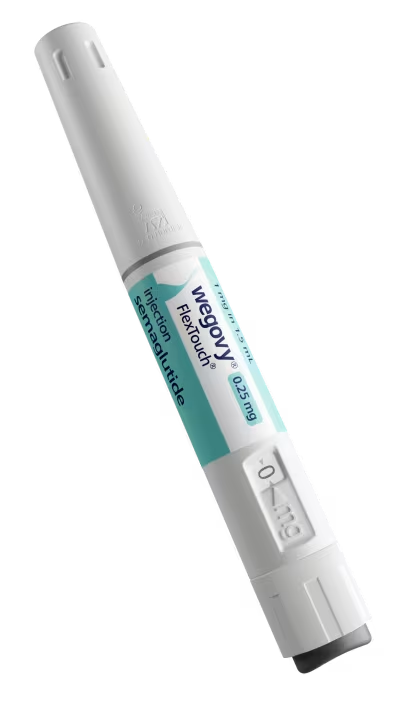
Semaglutide is a subcutaneous injection, meaning it goes into the fatty tissue under the skin rather than into muscle. Both Wegovy and Ozempic come in pre-filled FlexTouch pens that you dial to your dose.
The three approved injection sites are:
- Abdomen: At least 5 cm away from the navel. This is the most commonly used site and is easy to access.
- Thigh: The front or outer upper thigh, where there is enough subcutaneous fat beneath the skin.
- Upper arm: The back of the upper arm. This site often requires a second person to assist unless you have good flexibility.
There is no clinically meaningful difference in how semaglutide is absorbed between these three sites, so choose whichever you can access most comfortably and consistently.
How to inject Wegovy or Ozempic#
- Wash your hands thoroughly with soap and water.
- Remove the pen from the fridge and allow it to come to room temperature for around 15 to 30 minutes. Injecting cold medication can sting more.
- Check the pen: make sure the liquid is clear and colourless, and that the expiry date has not passed.
- Select your injection site and clean it with an alcohol swab. Allow it to dry fully before injecting.
- Remove the pen cap and attach a new needle. UK Wegovy FlexTouch pens come with needles in the box. Remove both needle caps.
- If this is a new pen, do a flow check: turn the dose selector to the flow check symbol and press the button until a drop appears.
- Turn the dose selector to your dose, insert the needle, and press and hold the dose button until the counter shows 0. Keep pressing and count slowly to 6 before you take the needle out.
- Put the used needle in a sharps bin and replace the pen cap. Each Wegovy pen holds 4 weekly doses.
Weekly semaglutide injections can be taken on any day, but keep it consistent: the same day each week, at roughly the same time. You don't need to take it with food.
If you're looking at semaglutide for weight loss and want to explore whether it's right for you, Totiva provides online weight loss consultations with UK-registered pharmacists.
Where to inject Mounjaro (tirzepatide)#
Mounjaro uses the same subcutaneous injection method as semaglutide. The approved sites are identical: abdomen (avoiding 5 cm around the navel), front or outer thigh, or the back of the upper arm.
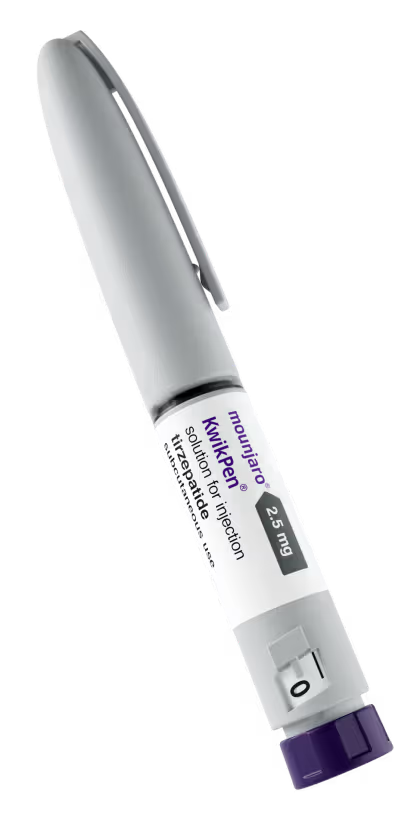
In the UK, Mounjaro comes in a KwikPen that holds 4 weekly doses. Needles are not included, so you need KwikPen-compatible pen needles.
The technique differs from Wegovy in two ways. You prime a Mounjaro KwikPen before every injection, not just the first: turn the dose knob until you hear 2 clicks, hold it needle-up and push the knob in. Then you turn the dose knob until the dose window shows 1, push it in until it stops at 0, and count slowly to 5. See our guide to priming a Mounjaro pen for the full steps.
Like semaglutide, Mounjaro is given once weekly and does not require food. If you miss a dose, you can take it within four days of the missed dose. If more than four days have passed, skip that dose and resume your normal weekly schedule.
For more information on Mounjaro and other weight loss injections available in the UK, take a look at Totiva's weight loss service.
Got a question about your medicines?
Message a GPhC-registered pharmacist on WhatsApp. A real person replies.
Rotating injection sites: why it matters#
Rotation is one of the most important habits to build with any injectable medication.
Using the same spot repeatedly causes the fatty tissue to harden over time, a condition called lipohypertrophy. Once this occurs, absorption becomes erratic and unpredictable, which can affect how well your medication works. You might notice lumps, numbness or thickening at a favourite site.
A simple rotation system helps:
- Divide each injection area into zones (for example, left and right sides of the abdomen, and left and right thighs).
- Move at least 2 to 3 cm from your previous injection point each time.
- Keep a note in your phone or use a simple tracker to remember where you last injected.
- Allow each site to recover fully before returning to it. With once-weekly injections, this is straightforward.
If you notice a lump or hardened patch, avoid that area until it resolves. This can take several weeks to months.
Injection technique tips for different body types#
This is something most guides overlook, but it genuinely matters.
Lower BMI or less subcutaneous fat: Use a shorter needle (0.5 inches or 4 mm for subcutaneous injections) and pinch the skin firmly to gather enough tissue. Injecting at a 45-degree angle can help ensure you stay in subcutaneous tissue rather than inadvertently going intramuscular.
Higher BMI: You may have more subcutaneous tissue, which is generally fine. Injection at 90 degrees is usually appropriate. The key is ensuring the needle reaches the fatty layer and doesn't stay in the dermis.
Older or thinner skin: Skin elasticity decreases with age, and subcutaneous tissue can become less forgiving. Gentle pinching and careful site rotation are especially important. If you notice bruising more easily, discuss this with your prescribing pharmacist or GP.
Managing injection site reactions#
Mild redness, itching or a small raised bump at the injection site is common, especially when you first start. These usually resolve within a day or two and are not a cause for concern in most cases.
More significant reactions, such as persistent swelling, spreading redness, pain lasting several days or any signs of infection (warmth, discharge, fever), should be reviewed by a clinician. Don't inject into a site that looks infected.
If you experience a widespread allergic reaction (hives, difficulty breathing, swelling of the face or throat) after any injection, seek emergency medical attention immediately. Severe allergic reactions to GLP-1 medications are rare, but they do occur.
For GLP-1 medications like Wegovy, Ozempic and Mounjaro, you can report side effects to the MHRA via the Yellow Card scheme.
Sharps disposal in the UK#
This is a legal responsibility, not just good practice. You cannot put needles or pen devices in your household recycling or general rubbish.
Your options in the UK:
- NHS sharps bin: Ask your GP surgery, pharmacist or local council about the free sharps bin collection scheme. Many areas offer a home collection service or drop-off points at pharmacies.
- Local council collection: Contact your local authority, as provision varies. Many councils run clinical waste collection services for residents on long-term injectable medications.
- Pharmacy return: Some pharmacies accept filled sharps bins for safe disposal.
Always fill your sharps bin to no more than two-thirds capacity before sealing and disposing of it.
A note on NHS vs private prescriptions#
Semaglutide (Wegovy) is available on the NHS for eligible patients via specialist weight management services, but access remains limited due to supply pressures and referral criteria. Mounjaro (tirzepatide) received NICE approval for weight management, and NHS rollout is ongoing, though currently limited.
Private prescription services like Totiva operate under GPhC regulation, offering the same clinical standards as NHS prescribing with greater flexibility and speed. If you're considering starting weight loss medication, you can begin a consultation here.
When to speak to a clinician#
Self-injection is safe when done correctly, but there are situations where you should contact your prescriber or a healthcare professional:
- Persistent or worsening injection site reactions
- Difficulty finding suitable injection sites due to lipohypertrophy
- Uncertainty about whether you injected correctly (for example, if the medication leaked)
- Any systemic symptoms after injecting: chest tightness, difficulty breathing, severe dizziness
Your prescribing pharmacist or GP can also refer you to a practice nurse for a practical demonstration if you'd prefer hands-on support before injecting at home.
Frequently asked questions
- 1
Wittert G et al. (2022). Subcutaneous testosterone enanthate: pharmacokinetics and patient experience. PMC / National Library of Medicine
- 2
Khera M et al. (2023). Testosterone therapy in men with hypogonadism: an update. PMC / National Library of Medicine
- 3
Leeds and York Partnership NHS Foundation Trust (2022). Self-injection of Testosterone: Patient Information. Leeds and York PFT NHS
View source - 4
MHRA (2023). GLP-1 receptor agonists: reminder of the potential side effects and to be aware of the potential for misuse. Drug Safety Update, GOV.UK
View source - 5
NICE (2023). Overview | Tirzepatide for managing overweight and obesity | Guidance. NICE Technology Appraisals
View source - 6
Wilding JPH et al. (2021). Once-Weekly Semaglutide in Adults with Overweight or Obesity. New England Journal of Medicine
- 7
NHS (2024). How to dispose of sharps (needles and syringes) safely. NHS Website
Medical Information: This article is for informational purposes only and does not constitute medical advice. Always consult a qualified healthcare professional before starting, stopping, or changing any treatment.