Can Perms Cause Hair Loss? Chemical Damage, Hormones, and What to Do Next
Perms can trigger hair loss through chemical damage, scalp irritation, or telogen effluvium. Here's how to tell what's happening and when to act.
Written and medically reviewed by:

Key Takeaways
Perms can cause hair loss through chemical damage, scalp burns, or triggering telogen effluvium. Most post-perm shedding is temporary and reversible. Hormones, nutritional deficiencies, and medications can make things worse.
Yes, perms can cause hair loss, but it helps to understand exactly why, because the type of hair loss matters a great deal when it comes to what happens next.
A perm uses strong chemical reducing agents to break apart the disulphide bonds in your hair's keratin structure, then reforms them around rods or rollers to create a lasting curl. That process, when done correctly by an experienced stylist, is generally safe. But when things go wrong (whether due to over-processing, leaving solution on too long, or applying a perm to already-damaged hair) the consequences can range from breakage and shedding to, in more serious cases, lasting follicular damage.
This article covers the different types of hair loss linked to chemical treatments, the role hormones and medications can play in making things worse, and what your options are.
How Perms Damage Hair#
The chemical used in most traditional perms is ammonium thioglycolate. It penetrates the hair shaft and breaks the disulphide bonds that give hair its structural integrity. A neutralising solution (usually diluted hydrogen peroxide) is then applied to reform those bonds in the new shape.
This is disruptive by design. The issue is that each chemical process leaves hair slightly more porous and fragile than before. Do it once on healthy hair, and the damage is usually manageable. Repeat the process too soon, combine it with bleaching or colouring, or apply it to hair that is already compromised, and you start to accumulate real structural damage.
Glyceryl monothioglycolate, used in so-called "acid perms", is associated with its own risks, particularly allergic contact dermatitis on the scalp. Research has shown this allergen can persist in hair for several weeks after application, meaning delayed reactions are possible even if the immediate treatment seemed fine.
Beyond the hair shaft itself, the scalp can be affected if the reducing solution makes prolonged contact with the skin. Chemical scalp burns, though not common with correct technique, can damage follicles directly and, if severe, may result in scarring that prevents regrowth in the affected area.
The Different Types of Hair Loss After a Perm#
Not all post-perm shedding means the same thing. There are a few distinct patterns worth knowing about.
Mechanical breakage is the most common, and it is not technically hair loss at all. When you see short, snapped strands rather than hairs with a root bulb attached, you are looking at breakage. The hair shaft has fractured due to chemical weakening or excessive tension during the setting process. This can look alarming, but it is largely cosmetic and will resolve as new hair grows through.
Telogen effluvium is genuine hair shedding, and it is a common response to physical or chemical stress on the body. The shock of a harsh chemical treatment can push a significant number of follicles into the resting (telogen) phase simultaneously, leading to diffuse shedding across the scalp roughly six to twelve weeks later. The timing often catches people off guard as they assume the perm went well, then see increased shedding weeks afterwards. The good news is that telogen effluvium is almost always reversible. Shedding typically peaks around three months and resolves within six to nine months as the follicles cycle back into growth.
Anagen effluvium is less common but more serious. This occurs when chemical damage disrupts follicles while they are in the active growth (anagen) phase. Hair may fall out quickly, often within days or weeks of the chemical application. This is most commonly associated with chemotherapy, but severe chemical burns to the scalp can cause a similar pattern.
Traction alopecia can also occur if hair is wound too tightly around rollers during the perm process. Repeated tension on follicles over time can cause them to miniaturise and eventually stop producing hair. Unlike telogen effluvium, prolonged traction can cause permanent damage.
Warning Signs That Something Has Gone Wrong#
A few weeks of slightly increased shedding after any chemical treatment is not unusual. The following signs suggest something more significant is happening:
- Shedding that is noticeably heavier than normal and continues beyond eight to twelve weeks
- Patchy hair loss rather than diffuse, even thinning across the scalp
- Scalp soreness, redness, or crusting that does not resolve within a few days of the treatment
- Visible scalp burning or blistering immediately after the procedure
- Hair that snaps easily with minimal tension, or looks significantly thinner in texture
- Loss of hair along the hairline or temples, which can indicate traction damage
If you notice patchy loss, that is worth taking seriously. Patchy alopecia, particularly if it appears in distinct coin-shaped areas, may be alopecia areata, an autoimmune condition that can be triggered or unmasked by physical stress. This requires a different approach to treatment entirely.
Risk Factors That Make Post-Perm Hair Loss More Likely#
Some people are more vulnerable to chemical-related hair loss than others. Pre-existing conditions matter a great deal here.
If your hair has already been bleached, coloured, or heat-treated, adding a perm on top significantly increases the risk of over-processing. The hair simply has less structural integrity to withstand another aggressive chemical application.
Nutritional deficiencies are an underappreciated confounding factor. Low ferritin (stored iron), vitamin D deficiency, and inadequate zinc are all associated with increased hair fragility and telogen effluvium. If your follicles are already under nutritional stress, a chemical trigger can tip the balance more easily. Women in the UK are particularly prone to iron deficiency, and it is worth knowing that ferritin levels in the low-normal range are often enough to affect hair, even if a GP does not flag them as clinically deficient.
Hormonal status also matters. Women going through perimenopause or with an underlying condition like PCOS or hypothyroidism may find that chemical treatments trigger more significant shedding than they would in someone with stable hormones. This is because hormonal imbalances already put follicles under stress, reducing their resilience.
Certain medications can have a similar effect. Anticoagulants, antihypertensives, antidepressants, anticonvulsants, and some hormonal therapies have all been associated with drug-induced telogen effluvium. If you are taking any of these and notice hair loss after a perm, the medication may be a contributing factor rather than the perm being solely responsible.
The Hormonal Picture#
Hormones deserve their own mention because they are a significant and often overlooked driver of hair thinning, particularly in women.
Androgens, specifically dihydrotestosterone (DHT), are the primary hormonal cause of androgenetic alopecia (pattern hair loss) in both men and women. DHT binds to receptors in genetically susceptible follicles and causes them to miniaturise progressively. In men, this typically produces a receding hairline and thinning at the crown. In women, it more often presents as diffuse thinning across the top of the scalp with the frontal hairline largely preserved.
Oestrogen has a protective effect on hair follicles, which is why many women notice fuller hair during pregnancy (when oestrogen is elevated) and increased shedding in the months postpartum as levels drop. The same mechanism contributes to hair thinning during perimenopause and menopause.
Progesterone deficiency, which can occur with stress, menopause, or hormonal conditions, may also play a role. Low progesterone increases the relative influence of androgens, which can accelerate follicle miniaturisation.
Thyroid hormones are essential for normal hair growth. Both hypothyroidism and hyperthyroidism can cause diffuse hair shedding, and this is often reversible once thyroid function is stabilised.
PCOS is worth specific mention. It is a common condition affecting roughly one in ten women in the UK, and elevated androgens are a core feature. Many women with PCOS notice hair thinning on the scalp alongside excess facial or body hair, which is a direct consequence of elevated DHT levels affecting follicles differently in different parts of the body.
Got questions? Speak to a pharmacist on WhatsApp now
Prefer to browse first? View treatments
What Blood Tests Should You Ask For?#
If you are experiencing unexplained hair loss, whether or not a perm is involved, your GP can arrange blood tests to identify underlying causes. Useful tests include:
- Ferritin (stored iron) - standard serum iron tests can miss deficiency at a follicular level
- Full blood count
- Thyroid function: TSH, free T3, and free T4
- Testosterone and SHBG (sex hormone-binding globulin) - relevant if PCOS is suspected
- Vitamin D
- Prolactin - elevated levels can indicate hormonal disruption
If NHS wait times are a concern, private blood test panels from services like Medichecks or Randox Health can give you a clearer picture more quickly, and these results can still be discussed with your GP or a pharmacist.
When to Seek Medical Advice#
Some degree of shedding is normal, and a single stressful event (chemical or otherwise) causing a temporary increase in hair loss is usually self-limiting. But the following warrant a GP visit:
- Hair loss that has not improved after six months
- Patchy or asymmetrical hair loss
- Scalp inflammation, scaling, or pain
- Hair loss accompanied by other symptoms (fatigue, weight changes, irregular periods, skin changes)
- Sudden, rapid shedding rather than gradual diffuse thinning
Your GP may refer you to a dermatologist through the NHS if an underlying cause needs further investigation. The British Association of Dermatologists provides patient information leaflets on various hair loss types, which can be a useful starting point for understanding what you are dealing with.
If you had a perm at a salon and believe the treatment was applied negligently (leaving solution on too long, burning your scalp, or applying it against your stated wishes about hair condition), you may have grounds to make a formal complaint. Under the Consumer Rights Act 2015, services must be carried out with reasonable care and skill. The Office for Product Safety and Standards oversees cosmetics regulation in the UK. Citizens Advice can help with the process if you are considering making a claim.
Treatment Options for Men With Pattern Hair Loss#
For men dealing with androgenetic alopecia, whether triggered or accelerated by any of the above factors, there are two well-established, evidence-based treatments.
Finasteride works by inhibiting the 5-alpha reductase enzyme that converts testosterone to DHT. By reducing DHT levels, it slows follicle miniaturisation and, for many men, supports some degree of regrowth. It is a once-daily oral tablet, prescription-only in the UK. Clinical trials consistently show it to be effective at slowing or halting male pattern hair loss, with most men seeing meaningful results within three to six months of consistent use. Through Totiva's hair loss service, finasteride is available from £14.99 for 28 tablets following a clinician-led consultation.
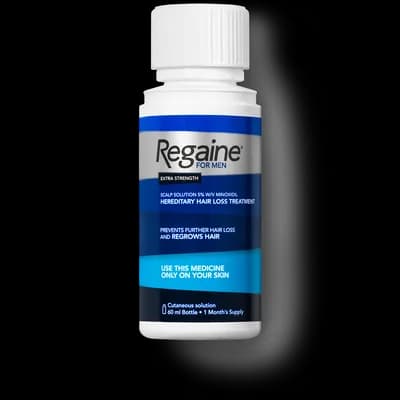
Minoxidil (available as Regaine and in generic forms) is a topical treatment applied directly to the scalp. It works by prolonging the anagen phase of the hair cycle and increasing blood flow to follicles. It is available over the counter in the UK and does not require a prescription. Regaine Liquid Solution is available through Totiva at £33.60 for 60ml or £79.99 for 180ml.
For men with more significant hair loss, combining both treatments is often the most effective approach. A combined finasteride and minoxidil regimen addresses the hormonal cause while directly stimulating follicles.
It is worth noting that Totiva's hair loss service is currently available for men only. Women experiencing hair loss should speak to their GP in the first instance, as the treatment pathways differ significantly.
If you are a man who has noticed gradual thinning, whether alongside a chemical treatment, a stressful period, or simply over time, a pharmacist-led consultation can help you understand your options. Start a free hair loss consultation with Totiva to find out whether treatment is appropriate for you.
Medical Information: This article is for informational purposes only and does not constitute medical advice. Always consult a qualified healthcare professional before starting, stopping, or changing any treatment.