








Why Do Men Go Bald? Genes, DHT and Sensitive Hair Follicles
Most male baldness is inherited. Your hair follicles react to the hormone DHT and shrink over time. Here is how it works, when it starts and what else can mimic it.


Key Takeaways
Most men go bald because of inherited sensitivity to the hormone DHT, which shrinks hair follicles over time. It can start after puberty. Other causes, such as illness or crash dieting, are often temporary.
Most men go bald because of genes, not lifestyle. Some hair follicles on the scalp are sensitive to a hormone called dihydrotestosterone (DHT). Over the years, DHT makes those follicles shrink until they grow only thin, short hairs, or none at all. The medical name is androgenetic alopecia, or male pattern baldness.
What DHT does to a hair follicle#
Your body turns some of its testosterone into DHT using an enzyme called 5-alpha-reductase. Most men have normal testosterone and DHT levels. The difference is how your follicles respond.
In follicles that are sensitive to DHT, each growth cycle gets shorter. The hair grows for less time, then falls out and is replaced by a finer, shorter one. This is called miniaturisation. Eventually the follicle produces only a barely visible fuzz.
The sensitive follicles sit at the temples, the hairline and the crown. The hair at the sides and back of your head is usually not sensitive. That is why many men end up with a horseshoe of hair, and why those back hairs are used in transplants. For more on the hormone itself, see our guide to DHT and hair loss.
Free 2-minute hair loss assessment
Tell us about your hair loss and a pharmacist will recommend the treatment most likely to work for you.
Does baldness come from your mum's or your dad's side?#
Both. It is a popular belief that you inherit baldness from your mother's father. The androgen receptor gene sits on the X chromosome, which does come from your mother, so there is a grain of truth in it. But it is only one piece.
A large UK Biobank study (Hagenaars and colleagues, 2017) found hundreds of genetic variants linked to male pattern baldness, spread across many chromosomes. You inherit these from both parents. So a bald father does raise your risk, and so does a bald maternal grandfather. Neither guarantees you will lose your hair, and neither rules it out.
How common is it, and when does it start?#
Male pattern baldness is the most common cause of hair loss in men. The NHS describes it as very common, and most estimates say roughly half of men have noticeable loss by 50. Often-quoted figures come from US research. A 1998 study of 18 to 49 year olds (Rhodes and colleagues) found moderate to extensive loss in about 16% of men in their 20s, rising to about half of men in their 40s. Good UK-specific numbers are scarce, so treat these as a guide.
It can start any time after puberty. Some men see a receding hairline at 18 or 19. Others do not notice anything until their 40s or later. Starting early tends to mean more extensive loss later, but the pace varies a lot from man to man.
Doctors grade it using the Norwood scale, which runs from stage 1 (no loss) to stage 7 (only a band of hair at the sides and back). Most men sit somewhere in the middle. A typical example is stage 3, with the temples receded into a clear M shape. From there it may stay put for years or move on gradually. Our guide to the early signs of male pattern baldness shows what to look for.
Is it male pattern baldness or something else?#
Not all hair loss is genetic. Other causes look different and behave differently, and some of them are reversible.
| Cause | What it looks like | Speed | Reversible? |
|---|---|---|---|
| Male pattern baldness | Receding temples, thinning crown | Slow, over years | Permanent, but can be slowed |
| Telogen effluvium | Thinning and heavy shedding all over | Starts about 2 to 3 months after a trigger | Usually regrows within about 6 months |
| Alopecia areata | Smooth, round bald patches | Can be sudden | Often regrows, may come back |
| Scarring alopecia | Patches with redness, soreness or scaling | Variable | Permanent, so early review matters |
Telogen effluvium is the one men most often confuse with pattern baldness. It happens when a shock pushes lots of hairs into the resting phase at once. Triggers include a high fever, surgery, crash dieting, iron deficiency and some medicines. Examples include retinoids, beta blockers, anticoagulants and some antidepressants. Once the trigger is gone, the hair grows back.
If you have patches, a sore or itchy scalp, redness, or sudden heavy shedding, see your GP. They may check for iron, thyroid problems and other causes with blood tests. Anabolic steroids and testosterone replacement can also speed up pattern baldness in men who are already prone to it.
Hair loss treatments we prescribe
The gold-standard hair loss combo
What does not cause it#
Several common beliefs have no good evidence behind them:
- Wearing hats does not make you bald.
- Shampoo and frequent washing do not cause pattern baldness. You will see more hairs in the plughole, but they were already due to fall out.
- Masturbation and sex drive have no link to hair loss.
- High testosterone is not the reason. Sensitive follicles are.
- Stress alone does not cause male pattern baldness. It can trigger temporary shedding, though.
What you can do about it#
Pattern baldness is progressive. The follicles keep responding to DHT, so treatment works by holding the line, not by curing the cause. Two medicines have good evidence.
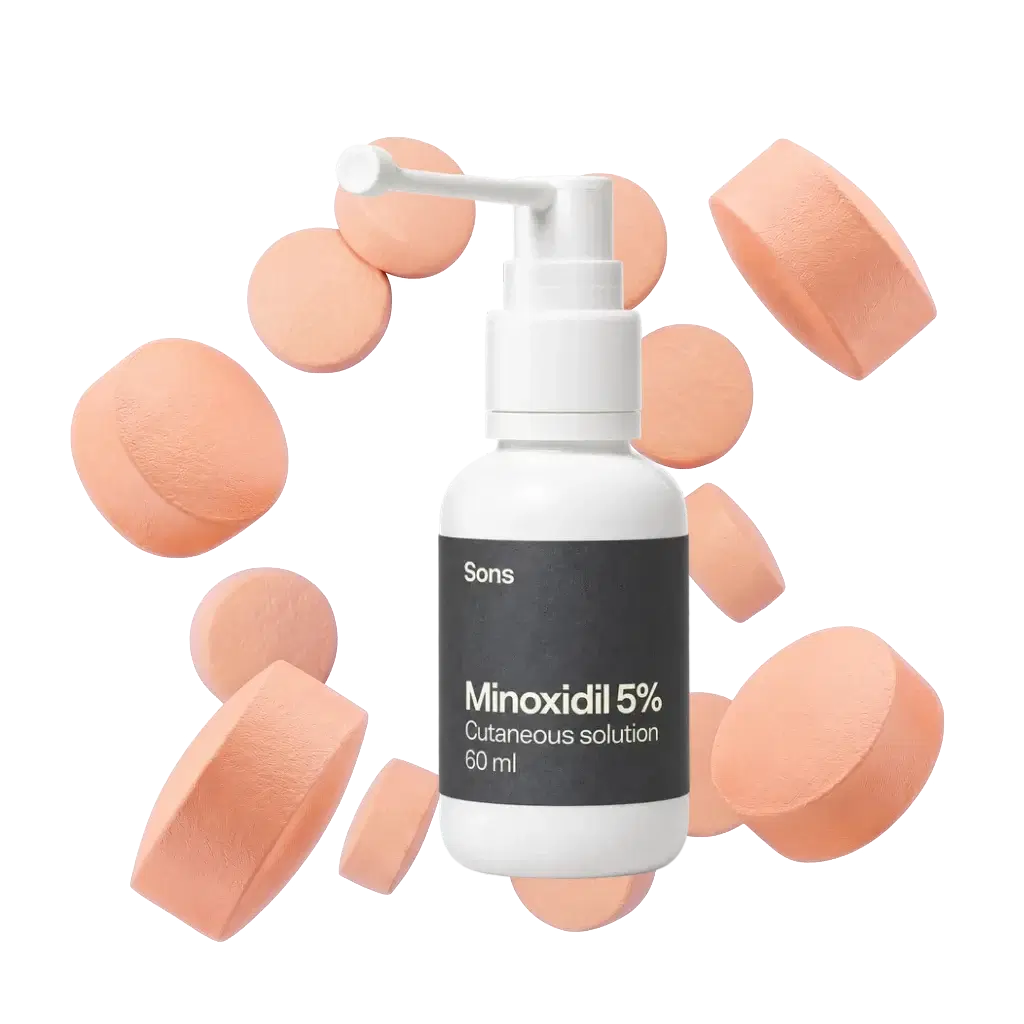
Finasteride is a prescription-only tablet that lowers DHT. The MHRA has warned about possible mood changes, including depression and suicidal thoughts, and sexual side effects. You should get a patient alert card, and you can report any side effects through the Yellow Card scheme. Minoxidil is applied to the scalp and can be bought over the counter in the UK. It helps keep hairs growing for longer. Either one needs months of use before you can judge it, and the benefit stops if you stop. The NHS does not usually fund treatment for male pattern baldness, so most men pay privately.
Other options include hair transplants, a shaved head or a well-chosen cut. Our guide on haircuts for thinning hair is a good place to start. If hair loss is affecting your mood, talking to your GP or to Mind is reasonable too.
If you think this is pattern baldness and want to talk through treatment, you can read about hair loss treatment at Totiva. A UK-registered clinician reviews every request. Hair loss treatment is for men only.
Is Finasteride right for you?
From£9.49
A short online consultation is all it takes. A pharmacist reviews your answers, and you only pay if you're approved.
- GPhC-registered pharmacists
- Free online consultation
- Discreet, tracked delivery
Frequently asked questions
- 1
NHS (2023). Hair loss. NHS Website
View source - 2
Hagenaars SP et al. (2017). Genetic prediction of male pattern baldness. PLoS Genetics
- 3
Ho CH, Sood T, Zito PM (2023). Androgenetic Alopecia. StatPearls Publishing
- 4
Rhodes T et al. (1998). Prevalence of male pattern hair loss in 18-49 year old men. Dermatologic Surgery
View source - 5
Malkud S (2015). Telogen Effluvium: A Review. Journal of Clinical and Diagnostic Research
Medical Information: This article is for informational purposes only and does not constitute medical advice. Always consult a qualified healthcare professional before starting, stopping, or changing any treatment.


